Quick start
A complete end-to-end screen of a multi-layer site, in fifteen lines. You will build a profile, compute stress, check a footing, predict settlement, and run a liquefaction triggering check.
The full example
import geoeq as ge

# 1. Define a layered profile with a water table -----------------------------
p = ge.SoilProfile([
    (0, 2,  ge.Soil("Fill",       gamma=18)),
    (2, 8,  ge.Soil("Soft Clay",  gamma=17, gamma_sat=18.5,
                                  phi=0, c=25, Cc=0.27, e=0.92)),
    (8, 20, ge.Soil("Dense Sand", gamma=19, gamma_sat=20.5, phi=35)),
], water_table=2.0)

print(p.stress_at(10))
# {'sigma': 188.0, 'u': 78.48, 'sigma_eff': 109.52}

# 2. Bearing capacity of a 3 m square footing -------------------------------
bc = ge.bearing_capacity(c=25, gamma=18.5 - 9.81,
                         Df=2, B=3, L=3, phi=0,
                         method="meyerhof")
print(f"q_u = {bc['q_u']:.0f} kPa")
# q_u = 192 kPa

# 3. Primary consolidation settlement under 15 kPa increase -----------------
S = ge.settlement_primary(Cc=0.27, e0=0.92, H=3.66,
                          sigma0=80, delta_sigma=15)
print(f"S = {S*1000:.1f} mm")
# S = 38.4 mm

# 4. Liquefaction triggering at the sand (NCEER simplified procedure) -------
csr = ge.liquefaction_csr(amax=0.25, sigma_v=120,
                          sigma_v_eff=70, z=6, Mw=7.0)
crr = ge.liquefaction_crr(N160cs=12, method="youd_2001")
fs  = ge.liquefaction_fos(csr["CSR"], crr["CRR"], Mw=7.0)
print(fs)
# {'FS': 0.58, 'liquefies': True, 'MSF': 1.19, 'K_sigma': 1.0, 'K_alpha': 1.0}
That is four lines of imports plus four short blocks — a complete geotechnical screen of a multi-layer site, ready for a report.
Step-by-step
1. Build the profile
A SoilProfile is a list of (top, bottom, Soil) tuples with an
optional water-table depth. Layers must be contiguous (no gaps, no
overlaps) and ordered top-to-bottom. Positive z is downward.
clay = ge.Soil("Soft Clay", gamma=17, gamma_sat=18.5,
               phi=0, c=25, Cc=0.27, e=0.92)
p = ge.SoilProfile([
    (0, 2,  ge.Soil("Fill", gamma=18)),
    (2, 8,  clay),
    (8, 20, ge.Soil("Dense Sand", gamma=19, gamma_sat=20.5, phi=35)),
], water_table=2.0)
Soil is a plain dataclass — only name is required, everything
else has sensible defaults. The fields you do not provide simply
will not be available downstream.
2. Compute stress at any depth
The profile integrates unit weights downward, applying \(\gamma\) above the water table and \(\gamma_{\text{sat}}\) below it. Pore pressure is hydrostatic from the water table down.
p.stress_at(10)
# {'sigma': 188.0, 'u': 78.48, 'sigma_eff': 109.52}

p.total_stress([2, 5, 10])         # vectorised — accepts arrays
p.layer_at(5).name                  # 'Soft Clay'
You can also plot the full \(\sigma\)–\(u\)–\(\sigma'\) vs depth profile:
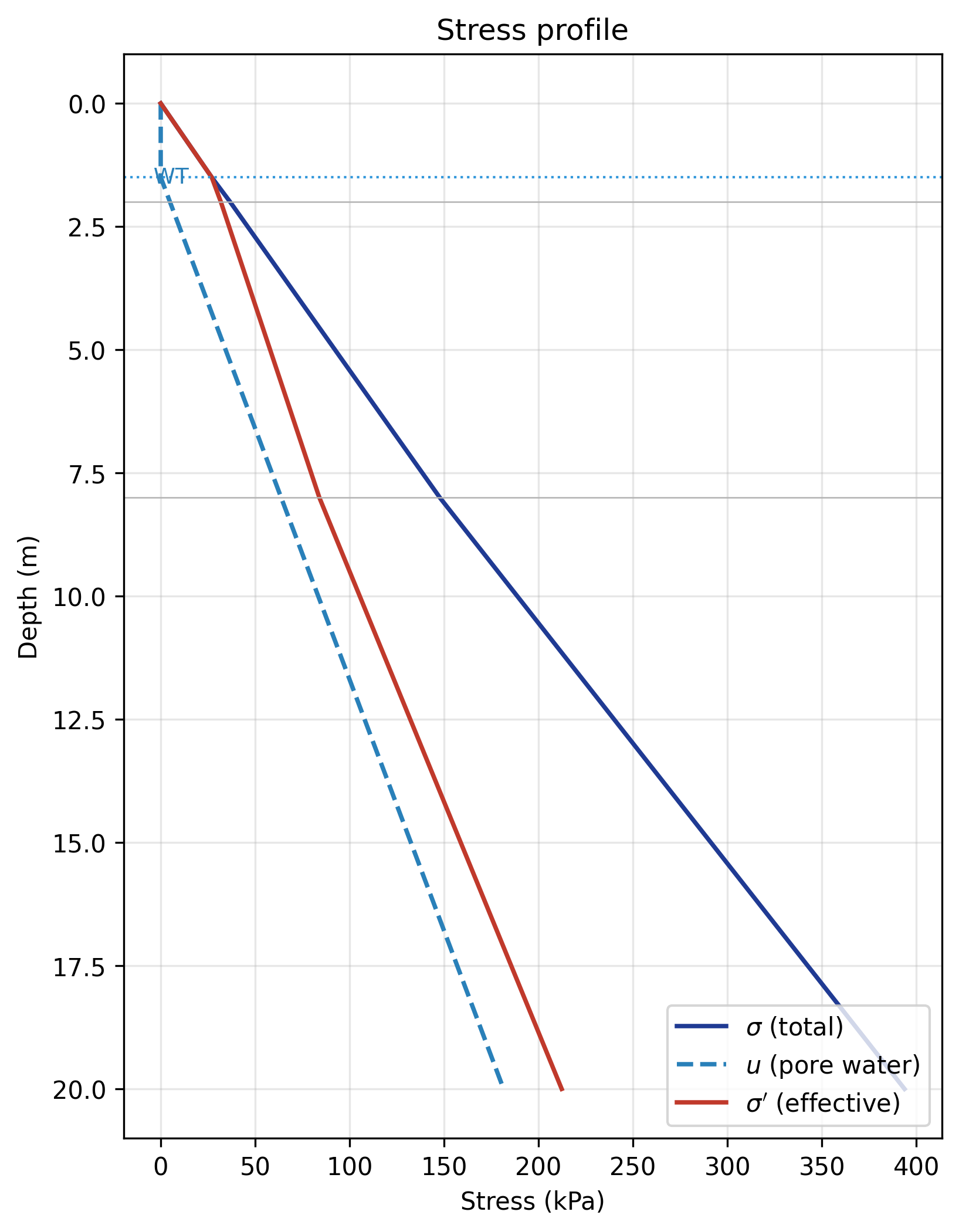
SoilProfile.plot().3. Check the footing — bearing capacity
bearing_capacity() implements the full Meyerhof / Hansen / Vesic
equation with shape, depth, and inclination factors selectable per
call.
bc = ge.bearing_capacity(
    c=25, gamma=18.5 - 9.81,   # effective unit weight under water
    Df=2, B=3, L=3, phi=0,
    method="meyerhof",
)
print(bc["q_u"])               # 192 kPa
Try all four methods to see how they compare on this footing:
for m in ("terzaghi", "meyerhof", "hansen", "vesic"):
    q = ge.bearing_capacity(c=25, gamma=8.7, Df=2, B=3, L=3,
                             phi=0, method=m)["q_u"]
    print(f"{m:9s} -> {q:.0f} kPa")
4. Predict settlement
For a saturated clay, primary consolidation:
S = ge.settlement_primary(Cc=0.27, e0=0.92, H=3.66,
                          sigma0=80, delta_sigma=15)
print(f"S = {S*1000:.1f} mm")    # 38.4 mm
The function handles NC / OC-below-pc / OC-crossing-pc automatically
via kind="auto". See the Settlement page
for full details including Schmertmann strain-influence for sand.
5. Liquefaction triggering
The complete simplified procedure (Seed & Idriss 1971, NCEER):
csr = ge.liquefaction_csr(amax=0.25, sigma_v=120, sigma_v_eff=70,
                          z=6, Mw=7.0)
crr = ge.liquefaction_crr(N160cs=12, method="youd_2001")
fs  = ge.liquefaction_fos(csr["CSR"], crr["CRR"], Mw=7.0)

print(fs)
# {'FS': 0.58, 'liquefies': True, 'MSF': 1.19, ...}
FS_L < 1 indicates liquefaction is predicted under the design
earthquake. See the Soil dynamics page for
the full triggering workflow and chart helpers.
Where to go next
- Tutorials: 25 chapter-by-chapter notebooks at Tutorials.
- API reference: every function with full docstring at API reference.
- Per-module guides: focused walkthroughs of each module's intent and methods at User guide.